
Self-employed tax receipts rocketed last year. Here’s how advice could bring your bill back down to Earth

Frozen Tax thresholds have caused self-employed tax receipts to skyrocket. Learn four ways you can bring your bill down with the help of a financial planner.
According to FTAdviser, self-employed Income Tax in July 2026 was £17.1 billion, an 11% increase on the previous year.
This jump is part of a long-term trend in rising tax bills, driven by the ongoing effects of frozen Income Tax and other thresholds.
If you are self-employed, keep reading to discover what options you have to improve your tax efficiency so it’s your wealth that rockets, not your tax bill.
Frozen Income Tax thresholds are increasing tax bills
The Personal Allowance and basic rate Income Tax thresholds have been frozen at their current levels since April 2021. Meanwhile, the level at which the additional rate begins to apply was reduced in 2023 (from £150,000 to £125,140), pushing more people into paying a higher rate of tax (45%).
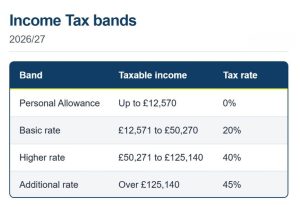
Frozen Income Tax thresholds are a form of stealth tax. Rather than introducing new taxes or raising existing ones, holding Income Tax thresholds at their current level increases tax revenue over the long term.
This causes an effect known as fiscal drag.
Wages and investments rise, yet Income Tax bands remain fixed, gradually pushing more income into taxable ranges.
Frozen Income Tax thresholds aren’t a short-term problem. These bands are fixed until April 2031, and Fidelity reports that the ongoing freeze will raise an additional £55.5 billion by the 2030/31 tax year.
4 strategies to reduce your Income Tax liability
Only the government can change frozen thresholds. However, there are various strategies that you might adopt to help you regain or improve your overall tax efficiency.
- Increase your pension contributions
Self-employed individuals can’t use salary sacrifice schemes as these are a workplace benefit.
Instead, you can increase your pension contributions to create more tax-efficient wealth.
Pensions are tax wrappers that offer you relief on pension contributions equivalent to the rate of Income Tax you pay. This means that tax you incur due to fiscal drag could be partially offset by increasing your pension contributions by a commensurate amount.
Think carefully before you use this strategy to reduce your Income Tax bill. Pensions are a long-term investment, and any wealth you put into one is locked away until your normal minimum pension age (55 in 2026/27, but increasing to 57 in April 2028).
- Use ISAs to shield your wealth from tax on growth
Income you earn from savings interest, dividends, and selling off assets can be liable for several forms of tax:
- Income Tax
- Dividend Tax
- Capital Gains Tax (CGT).
The threshold rates for these taxes have also either remained fixed or been reduced in recent years, increasing the risk of fiscal drag.
However, you might be able to shield your wealth by holding it in an ISA instead.
You don’t pay tax on interest earned in a Cash ISA, and Stocks and Shares ISA gains are free from Income Tax, Dividend Tax, and CGT.
This means you hold on to all the interest or profits you earn, provided you don’t breach the annual subscription limit.
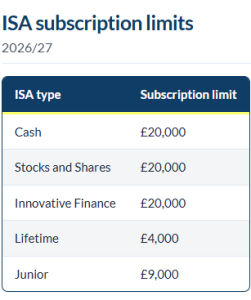
Please note that the subscription limit for Cash ISAs is reducing to £12,000 from April 2027 for under-65s.
A financial planner can help you decide how best to make use of these tax wrappers for your unique circumstances.
- Claim expenses back from HMRC
Self-employed individuals can claim back work-related expenses from HMRC. These expenses are deducted from your income, which can help lower your overall tax liability.
These might be:
- A new computer
- Travelling for business
- Utilities, like energy and water
- Employee salaries
For the cost to qualify as an allowable expense, it must be wholly, exclusively, and necessarily incurred in the performance of your duties or business.
A financial planner can also support your accountant to determine what is tax-deductible, helping you claim your expenses successfully.
- Discuss your options with a Kellands financial planner
Often the biggest challenge with fiscal drag is noticing it in the first place. Once you do, a number of strategies can help you overcome its effects.
Whether increasing pension contributions or taking advantage of ISAs is right for you depends on your circumstances and goals.
Find the answers you need with a Kellands financial planner.
We can help you understand how rocketing Income Tax receipts are impacting your wealth. By finding the right tax efficiency strategy, we can help more of your wealth go towards supporting your business and your personal goals.
Email us at hale@kelland.co.uk, or call 0161 929 8838.
Please note
This article is for general information only and does not constitute advice. The information is aimed at individuals only.
All information is correct at the time of writing and is subject to change in the future.
Please do not act based on anything you might read in this article. All contents are based on our understanding of HMRC legislation, which is subject to change.
The value of your investments (and any income from them) can go down as well as up and you may not get back the full amount you invested. Past performance is not a reliable indicator of future performance. Investments should be considered over the longer term and should fit in with your overall attitude to risk and financial circumstances.
The Financial Conduct Authority does not regulate tax planning.